
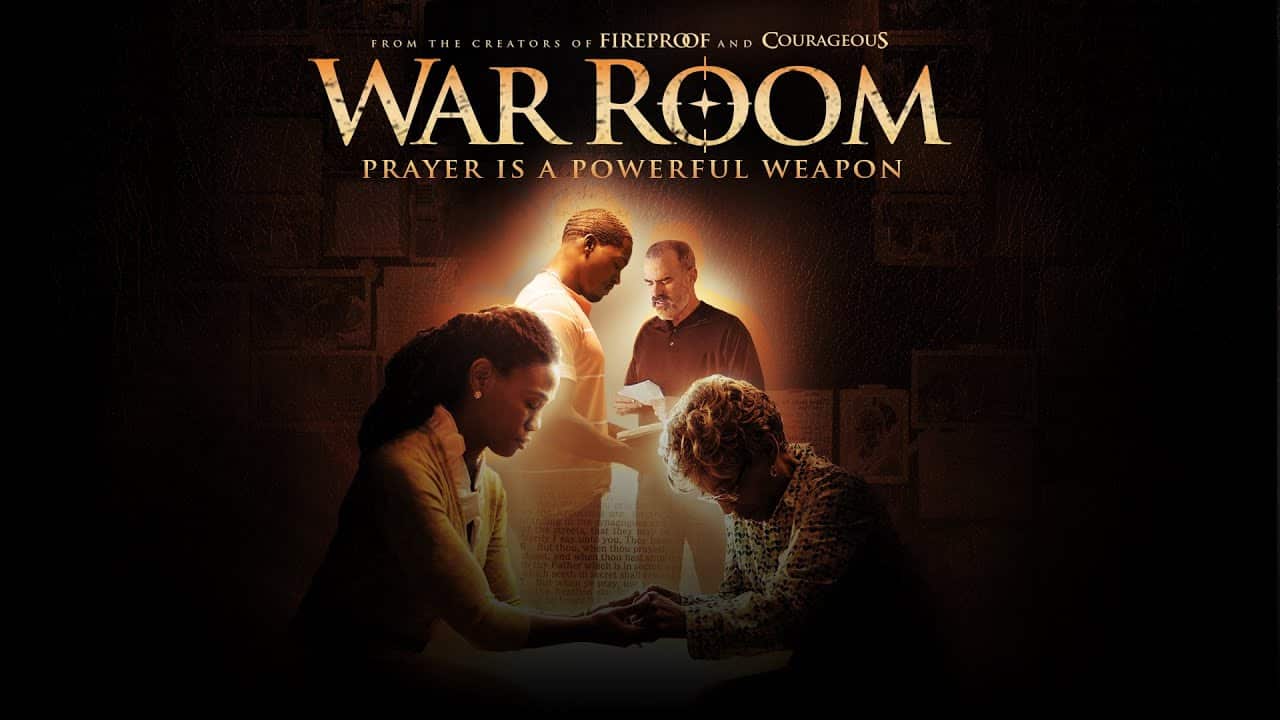
If you do not know the Kendrick brothers by name, you almost certainly know them by their films: Flywheel (2003), Facing the Giants (2006), Fireproof (2008), and Courageous (2011). Stephen, Alex, and Shannon Kendrick have just released their fifth faith-based film, War Room. War Room, starring popular Bible teachers Priscilla Shirer and Beth Moore, maybe the most successful of their movies to date, bringing in $11 million just on its opening weekend, more than triple its $3 million production budget.
Given the popularity of Christian-themed films and the considerable buzz about this one in particular, my wife, Kathy, and I went to see War Room on the evening of September 3rd so that I could write a review. For those of you who read my review of Mark Burnett and Roma Downey’s movie, Son of God, you know that I am a bit skeptical of the Christian movie genre as a whole. Nonetheless, I do want to offer what I hope to be a fair review. This review will not touch on every facet of the movie or even every theme it presents, but I hope to address what I believe to be the most important.
PLOT OVERVIEW
War Room is centered around Tony and Elizabeth Jordan, their ten-year-old daughter, Danielle, and Elizabeth’s real estate client-turned-Christian friend, Mrs. Clara. The Jordan marriage is in serious trouble. Tony, a pharmaceutical salesman who travels extensively in his work, is the kind of husband and father one loves to hate. Though a hard worker, he shows little interest in his daughter and pursues a female work interest behind his wife’s back. Elizabeth, played by Priscilla Shirer, goes to Mrs. Clara’s home to discuss putting it on the market. The meeting, however, went far beyond deciding on a listing price for the house.
Mrs. Clara, an older widow, is a Christian who is fiercely devoted to prayer, which she does in a closet she dubbed her “War Room.” Mrs. Clara goes to war here, battling Satan, who is portrayed as the source of every form of evil plaguing mankind. Rather than plotting troop positions on a military map, Mrs. Clara pins prayer requests and Scripture verses on the wall of her war room, prays to God, and rebukes the Enemy.
Mrs. Clara begins asking Elizabeth probing questions about her family, marriage, and church attendance. Upon learning that the Jordan family is at the point of collapse, Mrs. Clara exhorts Elizabeth to fight for her marriage in her war room.
Slowly but surely, Elizabeth is changed by her newly found prayer life and by reading the Bible. One day, in her war room, she discovers that Tony has been seen in a restaurant with another woman via a friend’s text. Elizabeth immediately prays for her husband and asks God to stop him. God gives Tony a stomach ache in the restaurant, preventing him from following through with his adulterous plans.
Shortly after this, Tony is fired from his job. Rather than the anger and sarcasm he expected to receive from Elizabeth upon hearing this news, she offered him love and support. The change he sees in his wife eventually changes Tony as well. He confesses his sin and turns back to God. He seeks and is granted forgiveness from Elizabeth and Danielle, and the Jordan family is on the fast track of restoration.
Despite his new life, Tony is fired from his job. What his boss did not know, though, was that Tony had been stealing drugs from the company, selling them, and pocketing the profits. Though he had gotten away with it, his now sensitive conscience drove him to return to meet with his former boss, confess his theft, and make restitution. His boss could have easily turned Tony into the authorities to face prison but chose not to. The Jordan family was spared the loss of being torn apart again just as it had begun to heal. Tony eventually found a new, though less lucrative, job, his family grew closer to one another, and the Lord, Mrs. Clara’s house was sold to a pastor and his wife, and all was well because of the battles fought in the War Room.
STRENGTHS
The movie was, of course, clean. There was neither foul language nor any innuendos (other than what was about to happen between Tony and his almost-mistress at the restaurant) anywhere to be found.
War Room emphasized the importance of fidelity to one’s spouse and cutting off any potential threats to the sanctity of the marital covenant. The film championed the virtues of character, integrity, and selflessness. The importance of family and the need for regular church attendance were stressed. Mrs. Clara (a very winsome character in the film) taught Elizabeth the importance of reading Scripture and prayer. The movie taught the biblical truth that man cannot reform himself. “You can’t fix Tony. Only God can,” said Mrs. Clara to Elizabeth.
The Gospel was, well, mostly there. Mrs. Clara presented the Gospel to Elizabeth in one of their meetings, and she talked about sin, that Jesus died on the cross to pay the penalty of sin, was raised from the dead, and that a person must believe in Jesus and repent. These are all essential elements of the Gospel, and I am glad they were included. That being said, even though the proper biblical terms were often not explained, these terms were often not explained. For example, “repent” was used but never fleshed out. The lingo was there, to be sure, but without a biblical understanding of these terms, they are just that, lingo.
WEAKNESSES
As I’m sure you are expecting, I did find much to be concerned about. Some of the film’s failures could have been avoided with more careful attention to doctrine and theology, and some of the failures, as I will explain in the conclusion, are inherent to the genre itself and unavoidable. I will outline my concerns in a series of “Outs:” Out of Home, Out of Order, Out of Focus, Out of Bounds, and Out of Context.
OUT OF HOME
I may as well begin with the most politically incorrect and probably the most controversial point I will make in this review and get it out of the way. Not everyone reading this will agree, but truth is truth.
That men and women are equally valued before God is beyond dispute (Gal. 3: 28-29). That being said, men and women have different roles, and the role of a young wife and mother is to be a worker in the home. The Apostle Paul writes that older women are to teach “the young women…to love their husbands, love their children, to be sensible, pure, workers at home, kind, being subject to their husbands so that the word of God will not be blasphemed” (Titus 2:4-5). Note the “workers at home” part.
The context makes it quite clear that the “young women” are those who are married and have children in the home. This text makes it quite clear that such women’s primary place of service is not to be outside of the home but within.
Pastor and teacher Dr. John MacArthur wrote that if a young woman adequately fulfills all seven requirements in this passage, she “will probably be a very busy individual” and have little time for work outside the home. If, however, “she still has time left over, then she would be free to pursue enterprising and creative activities outside the home.”1 It is not that a young woman should never engage in wage-earning work. Proverbs 31 depicts the godly woman who may do enterprising work from within the home.
One of the first things I noticed in the film is that Elizabeth worked outside the home as a real estate agent. Had she adequately fulfilled her duties inside the home, the case could have been made that this was permissible. This was not the case, however. The movie points out that Elizabeth was so involved in her job that she did not know what her daughter, Danielle, was doing at school or in her jump rope team.
Sadly, our fallen world often requires young women to work outside the home. Some “young women”2 have been abandoned by their husbands, and some may have husbands unable to work due to infirmity. In such situations, working outside of the home is, unfortunately, unavoidable.
When a young woman can avoid working outside the home, she should. A biblical principle has been violated if a young woman works outside the home out of preference rather than absolute necessity. The issue is not a minor one. Note that if a young woman works outside of the home at the expense of her biblical household duties, then the result is that the Word of God is βλασφημῆται (blasphemetai) blasphemed.
Writes Dr. MacArthur:
The home is where a wife can provide the best expressions of love for her husband. It is where she teaches and guides and sets a godly example for her children. It is where she is protected from abusive and immoral relationships with other men and where, especially in our day, she still has greater protection from worldly influences—despite the many lurid TV programs, magazines, and other ungodly intrusions. The home is where she has special opportunity to show hospitality and devote herself to other good works. The home is where she can find authentic and satisfying fulfillment, as a Christian and as a woman.3
OUT OF ORDER
War Room is a theological train wreck, chronologically speaking. In other words, it gets out of order the Holy Spirit’s work of regeneration in a person with the fruits of regeneration.
In their first meeting, Elizabeth tells Mrs. Clara about the distress of her marriage to Tony. Upon hearing this, Mrs. Clara asked, “Have you prayed for him?” There is nothing wrong with this in and of itself except that Mrs. Clara made this inquiry without first ensuring that Elizabeth understood the Gospel herself. Though Elizabeth certainly was not guilty of the overtly egregious sins of her husband, like he, she displayed little understanding of the Gospel. She attended church only “occasionally” and was biblically illiterate. There was no discernible spiritual fruit in her life to indicate that she was a believer.
Another example occurs after Elizabeth hears the Gospel (most of it anyway) from Mrs. Clara and begins to get on the straight and narrow. Shortly after Elizabeth found out about Tony’s attempt to cheat on her, he came home from his failed dalliance to a meal she had prepared for him. She looked at her husband and asked, “You wanna pray?” There is no reason to believe Tony has been converted at this point in the movie. He had little interest in Danielle and did not love his wife.4 He was selfish, arrogant, was a thief, and had no conviction over his sin. He cared only for himself, had no godly sorrow, and showed no affection for things holy and pure. He was ignorant of Scripture and comfortably so. That Elizabeth, by this time walking with the Lord, would ask her husband to pray assumes that this is something he could do which, as a lost man, he could not.
Save the prayer that one may pray at conversion; prayer is a spiritual discipline that can only be done by the saved. The movie gives the impression that praying for one’s spouse or asking God to bless the evening meal can be done by one who is lost. This, of course, is an impossibility. Before coming to Christ, we are enemies of God (Col. 1:21), dead in our sins (Eph. 2:8-9), and cannot seek Him (Rom. 3:10-11); a condition which precludes any ability to pray (Is. 59:2).
Now, this having been said, I am not saying that this was the intention of the Kendrick brothers. It is probably the case that they were portraying how people usually speak. I am not at all saying that theologically, they would believe that most people can pray. The problem, though, is the vagueness in which it was portrayed.
Additionally, and even more worrisome, the film gives the impression that one can live a life of habitual, unrepentant sin and still be a believer. In her war room, Elizabeth petitioned, “Lord, I pray for Tony that you would turn his heart back to you.”
My issue here is not that Elizabeth is praying for her husband, but that her prayer gives the viewer the impression that Tony was a just backslidden Christian.5 “Turn his heart back to You,” she prayed. Again, Tony was absolutely loathsome at this point in the movie, displaying zero evidence he had ever experienced regeneration.
Christians can and do sin (1 Jn. 1:8), but their lives are not to be characterized by sin. It has been said that a Christian can stumble into sin but not swim in it. A believer is a new creature in Christ (2 Cor. 5:17) indwelt by the Holy Spirit of God Who produces in him good fruit (Gal. 5:22-23). Many people living lives of habitual sin are told they are just “backslidden” when they’ve never slid forward in the first place. Charles Spurgeon stated, “Unless our faith makes us pine after holiness and pant after conformity to God, it is no better than the faith of the devils, and perhaps it is not even so good as that.” Whether intentional or not, there is a danger of this film giving some of its viewers a false assurance of their salvation.
OUT OF FOCUS
War Room certainly did deal with sin, but it did so, I thought, primarily on a horizontal basis. In other words, though it showed the damaging consequences of sin concerning our fellow human beings, it did not focus nearly so much on sin’s deadly consequences in our relationship with God.
Tony and Elizabeth both sinned in focusing on their employment at the expense of their daughter, Danielle. Of course, Tony sinned in pursuing a woman who was not his wife. Eventually, both came to see how their sin hurt others, and they repented. In and of itself, this is good.
What I did not see – or at least what I believed was not emphasized nearly enough – was the vertical nature of sin. There was no mention in the film of the wrath of God that our sin incurs. There was no mention of God’s wrath abiding on the unbeliever (Jn. 3:36) or that we are saved from it (Rom. 5:9). There was no mention of eternal judgment for those who die in their sins (Lk. 16:19-31).
Without first understanding the wrath of God, one cannot rightly understand the mercy of God. Without first realizing that our sins are storing up God’s wrath (Rom. 2:5), which will be poured out on the ungodly for all of eternity (Rev. 14:10), we cannot truly appreciate His mercy. Only by understanding God’s deserved wrath can we fully understand His undeserved mercy. It is His wrath that makes His mercy so precious.
In watching the film, both my wife and I were looking for one thing, which is a hallmark of every genuine believer: a godly sorrow over sin.
The Bible speaks of two types of sorrow over sin. There is a worldly sorrow which is merely a guilty conscience. A worldly sorrow is one that is concerned only with the horizontal consequences of sin, and it leads to death (2 Cor. 7:10).
The other type of sorrow, however, is a godly sorrow. Godly sorrow comes about when we understand that our sin is, first and foremost, against God. A godly sorrow is when we grieve over our sins because we understand that our sins grieve God, and we desire to turn from sins because we do not want to grieve Him. It is this godly sorrow that “produces a repentance without regret leading to salvation” (2 Cor. 7:10).
Unless we both missed it, neither Kathy nor I saw any godly sorrow evidenced in either Tony or Elizabeth’s life. There was sorrow over hurting others, but nowhere in the film did we see the kind of godly sorrow exhibited by David when he humbled himself before the Lord and said to Him, “Against You and You alone have I sinned and done what is evil in Your sight” (Ps. 51:4).
OUT OF BOUNDS
The Apostle Paul in 1 Corinthians 4:6 exhorts the immature believers in Corinth “not to exceed what is written.” In other words, we as believers are not to exceed biblical parameters. Whether in our theology or in our practice, we are to stay safely within biblical parameters, for when we exceed these God-given parameters, we are opening ourselves up to demonic influence and demonic deception.
Sadly, biblical parameters dealing with spiritual warfare are exceeded throughout the movie. The entire film is saturated with Word-Faith/N.A.R. spiritual warfare lingo.6 There seemed to be as much time and effort expended in binding, rebuking, and casting out Satan by Mrs. Clara and Elizabeth in their respective war rooms as there was praying to God.
In one of the more emotionally rousing scenes of the film, upon discovering her husband’s philandering ways, Elizabeth retreats to her war room. As she repeatedly cites to herself James 4:7b, “Resist the devil, and he will flee from you,” indignation swells within her, and she begins to talk to the devil. “No more, you are done! Jesus is Lord of this house, and there is no room for you anymore! Go back to Hell where you belong and leave my family alone!” she shouts.
There are at least two significant problems with this. First, Satan is not in Hell. Only when the eschatological events of Revelation 20 take place will he be thrown into the lake of fire and “tormented day and night forever and ever” (vs. 10).7 The Bible makes it very clear that, for now at least, Satan is entirely free, “prowling about like a roaring lion seeking someone to devour” (1 Pet. 5:8).
Secondly, and more significantly, we as believers are not to be addressing Satan. Ever!
Consider that in Jude, we have the record of Michael the archangel disputing with the devil and arguing over the body of Moses. Jude records for us that when he disputed with the devil, Michael the archangel “did not dare pronounce against him a railing judgment, but said, ‘The Lord rebuke you!’” Think about that for just a moment and let it sink in. If Michael, the archangel, did not “dare” to rebuke Satan, then I think it’s probably a safe bet that we should not do so. In his excellent book Truth or Territory, Pastor Jim Osman writes, “What God’s highest holy angel would not dare to do, sinful, fallen men presume the authority to do. It is unthinkable. I have been in the presence of Christians who boldly declare, ‘Satan, I rebuke you in the name of Jesus,’ and I wonder, ‘Who do you think you are?’ Rebuking, commanding, or ridiculing the devil are not tools of effective spiritual warfare; they are marks of prideful, arrogant, self-willed false teachers.”8
It is troubling that noted Bible teacher Priscilla Shirer does not know this and would model such a dangerous and unbiblical practice. People expose themselves to the enemy they fancy to rebuke by exceeding biblical parameters.9
Incidentally, given that so many people are rebuking and binding Satan, have you ever wondered how he seems to keep getting back out? It seems that when someone binds him, he’s free again. All of these people binding Satan don’t seem to be tying him up very tightly. And if we can bind and rebuke Satan (Be sure to bind him first. The last thing you’d want to do is rebuke an unbound Satan as he might give you a nasty uppercut when you’re not looking.), why not just bind him from all places at all times and be done with it?
But I digress.
The movie also has a decidedly mystical bent. Towards the end of the film, an older pastor named Charles and his wife, clients of Elizabeth, are shown the home. Charles notices the “war room ” closed door, opens it, and slowly walks inside. He looks around, pauses, backs out of the closet, and then walks back in as though he feels something different in the atmosphere. His wife asks him what he is doing, and he says there has been much praying in this room. “It’s almost like it’s baked in,” said the old pastor.
This is pure mysticism. God speaks to us through the Bible, and we talk to Him through prayer. Prayer is an act of obedience that serves to conform our will to that of the Father, but it in no way changes the atmosphere in a closet, house, hospital, gymnasium, state, or country. This is hyper-charismatic, Word-Faith mysticism.
In another scene, Mrs. Clara, Elizabeth, and Danielle are on their way to get ice cream when their trip is interrupted by a knife-wielding thug demanding their money. The unflappable Mrs. Clara looked at him and commanded, “You put that knife right down in the name of Jesus.” All of a sudden, the thug looked dazed and confused. Powerless to follow through with his criminal plans, he fled the scene. Saying “in the name of Jesus” to this miscreant was like giving Kryptonite to Superman.
Throughout the film, the name Jesus is used in this way. It is used almost like a magical incantation, a Christianized version of Abracadabra, to manipulate the physical realm toward one’s desired outcome. Whether used in prayer to restore a marriage or to thwart a mugging, the name of Jesus always had results in the War Room.
Contrary to how it is portrayed in the film, saying “in the name of Jesus” is not like putting coins in some theological vending machine. The name of Jesus is synonymous with the will of Jesus. When we rightly pray for things in Jesus’ name, we are praying for Jesus’ will to be done (Jn. 14:13-14; 1 John 5:14-15). Using the name of Jesus does not always bring the results we desire.
It was fidelity to the name of Jesus that led nearly all of the Apostles to gruesome deaths. It is fidelity to the name of Jesus that has brought horrific persecution to untold millions of Christians during the last two thousand years. Many Christians throughout the world face persecution to this day because of the name of Jesus. Sometimes, the name of Jesus does not get us what we want but what we may not like. Often, in times of trial and persecution for the believer, God is most glorified.
OUT OF CONTEXT
“The thief comes to steal, kill and to destroy; I have come that they might have life and have it abundantly” (Jn. 10:10) was quoted several times throughout the movie. In War Room, the “thief” is identified as Satan, who has come to steal people’s joy and marriages.
While it is not necessarily incorrect to identify the thief in John 10:10 as Satan, the passage’s context argues for a much broader view. The context indicates that the thief includes not only Satan but any false teacher who claims any way of salvation other than that which is found exclusively in Christ. The “thief” is attempting to steal not one’s joy or marriage but rather one’s reception of the Gospel itself. The context is that of salvation, not one of life enhancement.
The movie concluded with one of the most familiar, beloved, and yet taken out of context passages in the Old Testament, 2 Chronicles 7:14: “If My people who are called by My name will humble themselves, and pray and seek My face, and turn from their wicked ways, then I will hear from Heaven, and will forgive their sin and heal their land.” The text was shown superimposed on a shot of the United States capitol, the insinuation, of course, being that if we repent, God will heal our nation’s many societal ills.
Though a thorough treatment of this passage is beyond this article’s scope, applying this verse to the United States of America (or any other country for that matter) is to employ poor hermeneutics. The context of this verse is that it is God’s answer to Solomon’s prayer, dedicating the temple recorded in the previous chapter. There has only been, is now, and only will be one country in a covenant relationship with God – Israel.
Another aspect of the movie that was out of context is the entire premise of having a prayer closet in the first place. The film portrayed this room almost as having magical powers. If you want your prayers to be effective, it’s best to pray them in a closet emptied of its contents. Upon first consideration, this idea appears to have biblical support:
When you pray, you are not to be like the hypocrites; for they love to stand and pray in the synagogues and on the street corners so that they may be seen by men. Truly I say to you, they have their reward in full. But you, when you pray, go into your inner room, close your door, and pray to your Father, who is in secret. Your Father, who sees what is done in secret, will reward you. – Matthew 6:5-6.
As we were driving home from the theater that night, Kathy and I talked about how we would be willing to bet that thousands of people would see this film and then go to their homes, clean out a closet, and make their own “war rooms” believing that their prayers will become more effective.
Sure enough, just this morning, as I was writing this piece, I watched the Daystar channel as presidents and hosts Marcus and Joni Lamb played a clip from Eyewitness New Fox 58 as Aaran Perlman interviewed two of the Kendrick brothers. A visibly emotional Perlman said, “I saw this movie last weekend with a group of people; I’m gonna start crying before I even get into this. It changed my life so much. This movie is about prayer. It’s about finding a room called the war room, and immediately after this movie, I went home, ripped everything out of my closet, and made my war room.” “Wow, that’s incredible, awesome! You will see a difference in the days ahead. Write ‘em down so you can keep up with them. It’s great to check off those prayer requests to realize God is alive and well and at work in your life,” Stephen Kendrick responded.
While there is nothing wrong with praying in a closet, if that is what one wants to do, the location is not the point. The point Jesus made in this text was not about location but attitude. We are not to make a show of our prayers as did the scribes and Pharisees and should remove any distractions that may divert our attention away from the One to Whom we are praying. Sincere, humble prayers offered in a living room, a backyard, or an airplane at 40,000 feet halfway across the Pacific Ocean are heard just as well as those provided in an empty closet. Believing that there is some extraordinary power in the location itself is not only mystical but borders on idolatry. The Object of our prayers and the condition of our hearts are the important things – not the location.
CONCLUSION
Some will read this review and think I am too nitpicky and critical. I have talked to some who have seen War Room and thought it was great and had a solid biblical message. There is no doubt that the film was Christian-themed – an element that has drawn the ire of numerous secular critics – but we are enjoined to “test all things” (1 Thess. 5:21) through the lens of Scripture and to “study to show ourselves approved unto God” (2 Tim. 2:15). Charles Spurgeon once said, “Discernment is not a matter of simply telling the difference between right and wrong; rather it is telling the difference between right and almost right.”
Finally, as I hinted at the beginning of this piece, I do not like the whole Christian movie (I do not include documentaries) scene. It is not that I am inherently opposed to the genre per se, but rather that I believe they have an inherent danger. For one, Christian movies must be intentionally vague regarding many doctrinal matters to be successful at the box office. Christian films never really go past the basics of the Gospel and often fail at that. Yet the Bible says that we are to pay close attention to doctrine (1 Tim. 4:13) and to persevere in it (vs. 16).
Additionally, these movies are highly emotional. They tug at our heartstrings. There is nothing wrong in and of itself with emotion, but emotion cannot be a substitute for obedience to objective biblical truth. Movies in and of themselves cannot bring lasting change to anyone’s life. It seems that something new is introduced to the evangelical masses every few years or so and is portrayed as the next great evangelistic super-tool. Whether it’s a blockbuster movie like The Passion of the Christ or best-selling books like The Purpose-Driven Life or Jesus Calling,10 people get excited. Spin-off products follow, and incredible money is spent chasing the latest fads. But they are just that – fads. Recall the Prayer of Jabez craze about fifteen years ago. Remember how everyone was praying for God to enlarge their territory? Do you have any friends still praying the prayer of Jabez? Me neither. Without a foundation of sound doctrine or a constant and proper hermeneutic, all these things are the spiritual equivalent of a sugar pill.
It is a sad commentary, in my estimation, that so many professing believers get so excited about the latest thing to come down the evangelical pike but show little enthusiasm and put precious little effort into reading, studying, and obeying God’s Word. Watching a movie is easy. Laboring in the Word is not. But only the latter will bear fruit that remains.
Footnotes
- Is It Wrong for Wives to Work?
- For this article, when I write “young women,” I refer to the biblical definition of the term per Titus 2.
- Does Scripture Permit Women to Work Outside the Home?
- No matter how he may argue, if a man cheats on his wife (or vice versa), he does not love her. Such a sin breaks the marriage covenant and directly contradicts the biblical definition of love.
- The New Testament never uses this word. It is only used in the Old Testament about Israel.
- The New Apostolic Reformation is a twin movement of Word-Faith but has even more emphasis on signs and wonders and modern-day Apostles. Some of its prominent leaders include Bill Johnson, John Arnott, C. Peter Wagner, Cindy Jacobs, and Heidi Baker.
- Technically, there will never even be a time when Satan resides in Hell. Revelation 20:14 states that Hell and death are thrown into the lake of fire, where Satan and the demons will already be by that time. It is a distinction with probably little meaningful difference, but a distinction nonetheless.
- Osman, Jim (2015-01-24). Truth Or Territory: A Biblical Approach to Spiritual Warfare (Kindle Locations 1905-1908). Jim Osman, Kootenai Community Church. Kindle Edition.
- For an excellent book on spiritual warfare from a biblically sound perspective, see Pastor Jim Osman‘s Truth or Territory: A Biblical Approach to Spiritual Warfare. Also available is an eight-episode video series on this topic by Jim Osman on AGTV.
- All these mentioned have massive doctrinal errors.